The Frog Prince: a journey of inner transformation and lunar symbolism
The Frog Prince: a journey of inner transformation and lunar symbolism
by Hasan Andrea Abou Saida
The tale of the Frog Prince is one of the most fascinating and iconic narratives in the panorama of European fairy tales. This story, which has crossed centuries and cultures, explores themes of transformation, promise, and love, employing an imagery rich in ancient symbols and meanings.
The Grimm Brothers’ version, collected in the 19th century and titled “The Frog King, or Iron Heinrich” (Der Froschkönig oder der eiserne Heinrich), is perhaps the most well-known, but the story of the frog who transforms into a prince has much older roots. Its origins lie in oral traditions that spread across Europe and beyond, with influences reaching back to earlier eras and various cultures. The Grimm Brothers are believed to have gathered this story from the oral tradition of the Wild family in Kassel, although the exact source remains uncertain. This fairy tale is linked to ancient pagan beliefs, legends of transformation, and stories of human and animal metamorphosis, which were common in the mythologies of various cultures, including Greek mythology.

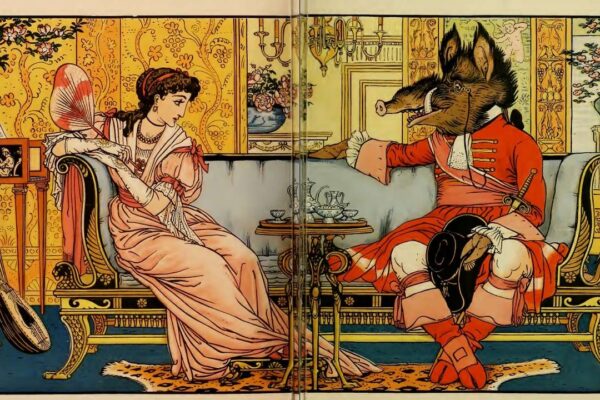
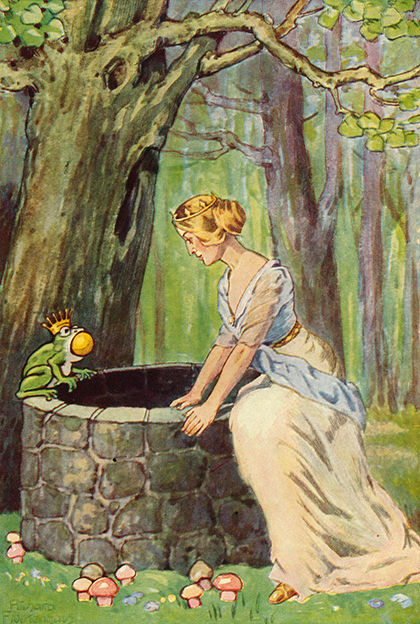
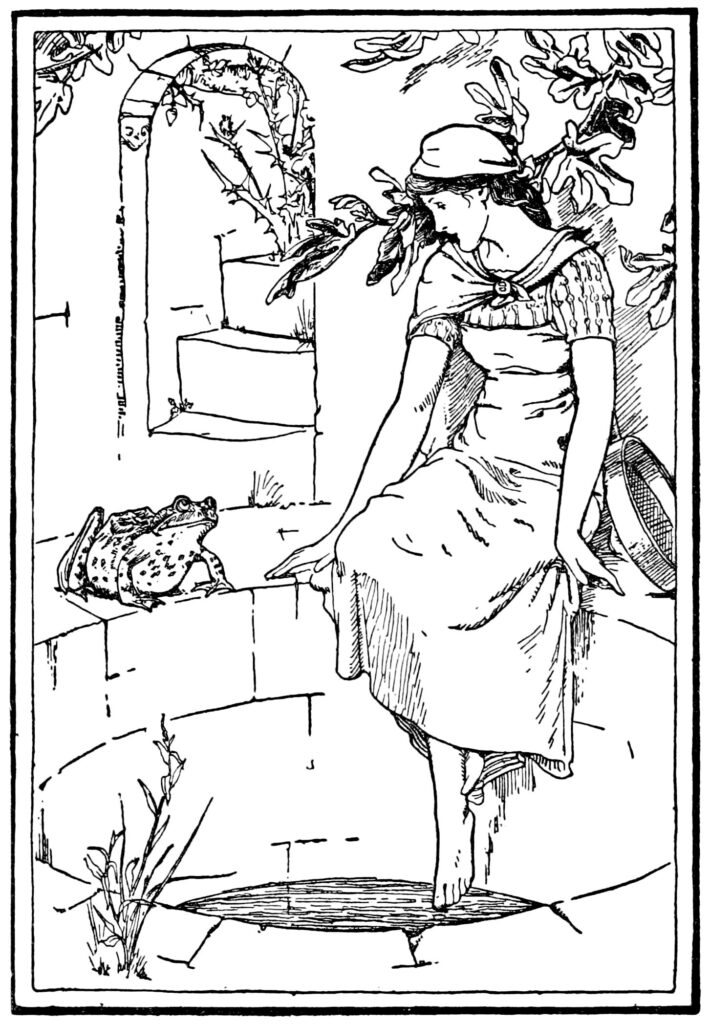
In the German version by the Grimm Brothers, the story unfolds around a young princess who loses her golden ball in a well. A frog, offering his help in exchange for the promise of becoming her companion, retrieves the ball. Despite her promise, the princess tries to avoid fulfilling her commitment, but the frog follows her to the palace. The final transformation occurs through a violent act: in some versions, the princess throws the frog against a wall, while in others she kisses him, and thus the frog transforms into a prince. This tale of transformation—both physical and inner—brings to light the central theme of the fairy tale: the possibility of change and self-improvement, suggesting that love and compassion can reveal a person’s true nature.
The symbolism in the fairy tale is rich and layered, with the frog representing a powerful symbol of metamorphosis. In reality, the frog undergoes a complete transformation from tadpole to adult amphibian, and in the fairy tale, this metamorphosis reflects hidden potential and inner beauty that is not immediately visible. The frog’s humble and unappealing nature can be seen as a metaphor for the positive qualities concealed behind an unattractive exterior.

The psychoanalyst Carl Gustav Jung interpreted this fairy tale as a story of the initiation of a young woman’s psyche. According to Jung, the princess’s ego represents the maiden who perceives male companions as animals. The golden ball symbolizes the Self, lost in the unconsciousness represented by the pond. In attempting to recover her Self, the woman encounters the frog, who desires intimacy with her. Although initially repulsed, the princess unconsciously acknowledges masculinity, eventually coming to see the frog as a desirable man. This psychological transformation of the princess parallels the frog’s physical transformation into a prince, and together they represent the passage from youth to adulthood, and from virginity to maturity.
The fairy tale of the Frog Prince is not unique in its narrative structure and symbolism. In fact, numerous European variants offer different interpretations of the same story of transformation. In some French versions, for example, the frog is replaced by a snake—an animal with more complex and often negative connotations in European culture and religion. Like the frog, the snake is also a symbol of transformation, but it carries an ambivalent meaning that reflects the duality of its nature.
A Scottish variant of the fairy tale, titled The Well of the World’s End, introduces an even more violent and symbolic element: after the frog helps the princess solve a problem, she beheads him, and only then does he transform into a prince. This act of decapitation can be interpreted as a rite of passage or a test of loyalty, further enriching the tale’s symbolic complexity.
The fairy tale may have even older roots, dating back at least to the Roman era. In Petronius’ Satyricon, a character remarks: “qui fuit rana nunc est rex” (“The man who was once a frog is now a king”). This could be a reference to the same story, or, as some scholars argue, a satire directed at Emperor Nero, who was often mockingly compared to a frog.
Beyond its role in fairy tales, the frog has held strong symbolic significance in various cultures, especially in Europe. In the Middle Ages, frogs and toads were often associated with death and magic. Iconographically, they were linked to the personification of the “Lady of the World,” Death, and frequently appeared on funerary monuments alongside the bodies of the deceased. This association between the frog and death, however, was not necessarily negative; rather, the frog symbolized the cyclical nature of life and death, and the possibility of rebirth.
“Animals are not only themselves; they are also the collective symbols of our inner life.”
— C.G. Jung, Man and His Symbols
The symbolism of the frog was also explored by the renowned psychoanalyst Bruno Bettelheim in his essay The Uses of Enchantment. Bettelheim interpreted the frog as a symbol of metamorphosis and birth. Just as the frog emerges from the water after undergoing a transformation, so too does the human being emerge from the mother’s womb, surrounded by the amniotic waters, undergoing a similar transformation. This capacity for change has made the frog a powerful symbol in fairy-tale narratives, linking it to magic and metamorphosis.

In the story of the princess and the frog, one can read the process of a young woman’s sexual initiation as she moves along her path toward adulthood. The fountain, where the princess loses her golden ball, can be interpreted as a symbol of self-discovery and introspection, representing the innocent exploration of deep and unknown parts of her own personality. At this stage, the princess has not yet gained full awareness of her own sexuality or of the world around her.
The innocent game with the golden ball at the fountain represents the initial, carefree attraction toward the self, which is suddenly confronted with the reality of darker and more complex forces, symbolized by the appearance of the frog.
This creature, initially seen as repulsive and unpleasant, embodies the masculine drives that the young girl finds disturbing and alien. The frog’s croaking, with its persistence and intrusiveness, reflects the early approach to male sexuality, perceived as invasive and potentially threatening.
The golden ball that the princess holds in such high regard represents the core of her femininity— a radiant allure at the center of her identity. However, the frog is not merely a metaphor for male puberty, which brings changes that appear unwelcome and incomprehensible to girls of the same age; it also symbolizes male sexuality in general, seen as a powerful and unsettling force that initially provokes fear and disgust in the young woman.

When the princess, after her initial surprise and disgust, confronts the intruder with a rebellious gesture (the act of hurling the frog against the wall), a critical moment in her journey of growth emerges.
This action represents the inner struggle against the fear and uncertainty that accompany the encounter with the opposite sex. The princess, initially frightened and reluctant, gradually begins to acknowledge and accept the presence of male sexuality in her life.
Through this transformation, the princess moves from a state of innocence and fear to one of greater awareness and maturity. The frog, which at first appeared to be merely an obstacle, is revealed to be a prince — a symbol of an ideal and desirable partner, capable of completing the young woman’s growth process. This change reflects the princess’s ability to overcome her fears and embrace her sexuality as an integral part of her identity.
“The privilege of a lifetime is to become who you truly are.”
— C.G. Jung, Modern Man in Search of a Soul
The green color of the frog can be interpreted as a symbol of hope and rebirth. The frog’s transformation into a prince represents the transition from a state of immaturity and confusion to a new stage of life, characterized by awareness and acceptance of one’s sexual identity.

From this perspective, the tale reflects the inner struggle and journey that many young women face in the transition from childhood to adulthood. Through confronting the unfamiliar and her initial feelings of repulsion, the princess learns to accept and integrate new dimensions of her life, ultimately finding a balance between her inner world and external reality. The story thus becomes an allegory of growth and change, in which the protagonist emerges as a strong and self-aware woman, ready to embark on the path of adult life with courage and determination.
Another cultural context in which the frog serves as a link to the feminine, sexuality, and the lunar cycle is found in Egyptian mythology, where it is associated with the goddess Heket. This deity, depicted either as a frog or as an anthropomorphic figure with the head of a frog, was the goddess of fertility and rebirth. The ancient Egyptians regarded the frog as a symbol of abundance, prosperity, and new life, due to its ability to lay a large number of eggs and its prolific presence in wet environments.
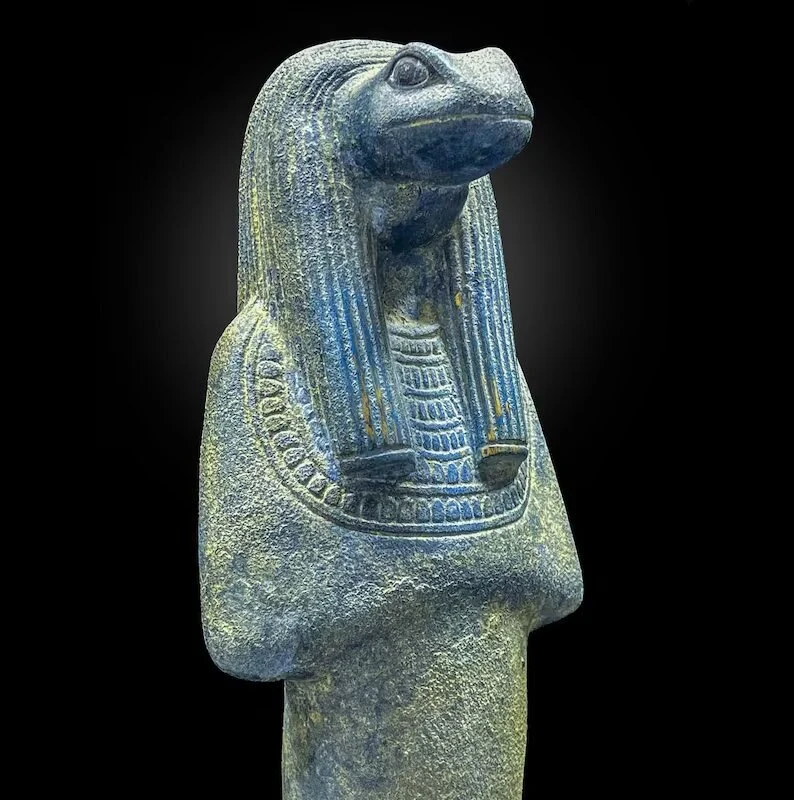
Heket was invoked during childbirth and regarded as a protector of births, especially multiple ones. The life cycle of the frog, closely observed by the Egyptians, was seen as a metaphor for rebirth and regeneration—concepts fundamental to Egyptian spirituality. The frog goddess symbolized life emerging from death, the hope of an afterlife, and the fertility that ensured the continuation of life on Earth. Heket was also considered a lunar deity, as the moon was associated with fertility and birth.
Bibliography
Bettelheim, B. (1976). The Uses of Enchantment: The Meaning and Importance of Fairy Tales. Knopf.
Grimm, J., & Grimm, W. (2013). The Frog King, or Iron Heinrich. In Fairy Tales. Einaudi.
Jung, C. G. (1964). Man and his symbols. Doubleday.
Jung, C. G. (1933). Modern man in search of a soul. Harcourt, Brace & World.
Jung, C. G. (1956). Symbols of transformation. Princeton University Press.
Petronio. (2017). Satyricon. Feltrinelli.
Phillpotts, B. (1910). The Well at the World’s End: A tale. James Nisbet & Co.
Wilkinson, R. H. (2003). The complete gods and goddesses of ancient Egypt. Thames & Hudson.
Zipes, J. (2002). Fairy tales and the art of subversion. Routledge.